Many people feel stuck in their careers not because they lack talent, but because they lack a clear plan. They know they want growth or change, but they don’t know what to do next.
This is where a career roadmap becomes essential.
A career roadmap does not tell you what your entire future should look like. Instead, it helps you move forward with clarity by focusing on practical, achievable next steps based on your current career stage.
At CareerLayers, career roadmaps are designed to support career discovery and growth in a structured, realistic way.
What Is a Career Roadmap?
A career roadmap is a step-by-step plan that outlines how you can progress from where you are today to where you want to be next.
Unlike rigid long-term plans, a career roadmap:
- Focuses on short- to medium-term goals
- Adapts as skills, interests, and opportunities change
- Aligns actions with your current career layer
It acts as a guide, not a guarantee.
Why Career Roadmaps Are Important
Without a roadmap, career decisions often feel reactive:
- Applying randomly to jobs
- Switching roles without clarity
- Learning skills without direction
A career roadmap helps you:
- Prioritize what matters now
- Avoid unnecessary detours
- Build momentum through small wins
- Reduce career-related anxiety
Instead of guessing, you move forward with intention.
Career Roadmaps Work Best When Combined with Career Discovery
Career roadmaps are most effective when they are built on career discovery.
Before creating a roadmap, it’s important to understand:
- Your interests and strengths
- Your current career layer
- Your constraints (time, resources, experience)
- Market realities
Career discovery ensures that your roadmap is realistic and aligned, not aspirational without direction.
The Key Elements of a Career Roadmap
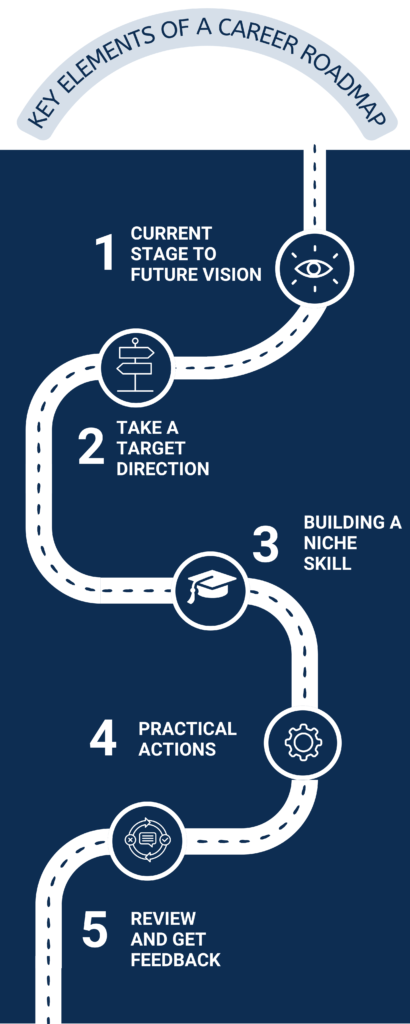
Let’s discuss all these elements in detail:
1. Current Stage to Future Vision
Understanding your future vision and where you are today:
- Skills you already have and how can you leverage them for future.
- Experience that can help you achieve your goals faster.
- Challenges you are facing can becoming your stepping stones.
This prevents planning based on assumptions.
2. Take a Target Direction (Not a Final Destination)
Instead of a fixed job title, focus on a direction:
- Take up a role which aligns with your experience or interest.
- Focus on developing the skillset.
- Feel free to learn about other skills which compliments the main skill.
This keeps your roadmap flexible.
3. Building a Niche Skill
Go Deep level finding all your answers on a particular Niche:
- By now you would know what core skills are needed next.
- Transferable skills to strengthen your core competency.
- Address the knowledge gaps.
This step turns ambition into action.
4. Practical Actions
Roadmaps should include:
- Learning activities like courses, tutorials, live sessions, seminars etc.
- Developing projects or experience-building steps.
- Networking with the people associated to that skill or exposure opportunities
Small, consistent actions matter more than drastic changes.
5. Review and get Feedback
Careers evolve, so roadmaps should too.
Regular reviews and feedbacks help you:
- Adjust your short term and long term goals.
- Change direction if things are not happening as intended.
- Stay aware about the new insights.
A roadmap is meant to evolve with you.
Career Roadmaps for Different Career Stages
For Students
Career roadmaps help students:
- Explore options without pressure
- Choose education paths thoughtfully
- Build skills early
- Avoid rushed decisions
The goal is awareness and preparation, not immediate specialization.
For more insights check out this article on Career Discovery For Students
For Working Professionals
Professionals use career roadmaps to:
- Plan growth within their field
- Prepare for promotions
- Transition into new roles gradually
- Avoid stagnation
Roadmaps provide clarity without forcing sudden changes.
For more insights check out this article on Career Planning for Mid-Career Professionals
For Career Switchers
For career switchers, roadmaps are critical.
They help:
- Identify transferable skills
- Reduce the risk of starting over
- Plan transitions step by step
- Balance learning with existing responsibilities
This makes career changes more manageable and less intimidating.
Common Mistakes People Make Without a Career Roadmap
Without a roadmap, people often:
- Follow trends blindly
- Overinvest in random skills
- Feel overwhelmed by choices
- Compare themselves to others at different stages
A career roadmap replaces confusion with structure.
How CareerLayers Approaches Career Roadmaps
CareerLayers builds career roadmaps based on:
- Career layers, not assumptions
- Individual context, not generic advice
- Progression, not perfection
Each roadmap focuses on helping users:
- Identify their next career layer
- Understand what skills matter now
- Take practical, achievable steps
This approach supports sustainable career growth.
Career Roadmaps Are Guides, Not Guarantees
It’s important to remember that no roadmap can predict the future perfectly.
Career roadmaps are meant to:
- Provide direction
- Reduce uncertainty
- Support better decision-making
They empower you to move forward confidently while staying adaptable.
Final Thoughts
Career growth does not require having everything figured out today. It requires clarity about what comes next.
A well-designed career roadmap helps you:
- Focus on the right actions
- Build confidence through progress
- Navigate change with intention
By combining career discovery, career layers, and career roadmaps, individuals can build careers that grow naturally over time.
The journey becomes clearer when you focus on the next step, not the entire staircase.